Table of Contents
- What Makes the 6th Gen Bronco a Strong Off-Road Platform
- Ford Bronco Auxiliary Lighting: Roof Bars, Bumper Pods, and Light Bars
- Bronco Electrical Accessory Installation: Switching and Power Distribution
- Exterior Protection: Skid Plates, Rock Sliders, and Bumper Upgrades
- Storage, Cargo Management, and Recovery Gear for Off-Road Bronco Builds
- Weight, Fuel Economy, and Warranty: What Bronco Owners Often Overlook
- Terrain-Specific Recommendations: Matching Accessories to Your Trail Type
- Conclusion
Last Updated: August 26, 2026
The 6th Gen Ford Bronco arrived with factory-engineered mounting points, modular bumpers, and a body-on-frame chassis designed to accept bolt-on upgrades. For owners building a trail-ready rig, the aftermarket offers a strong catalog of off-road accessories spanning lighting, exterior protection, cargo management, and recovery gear.
What Makes the 6th Gen Bronco a Strong Off-Road Platform
The 6th Gen Bronco's body-on-frame architecture allows proper skid plate mounting, rock slider attachment to frame rails, and aftermarket bumper integration without compromising structural integrity. Ford engineered the platform with OEM "Accessory Ready" roof ports, pre-routed wiring for auxiliary lighting, and a modular front bumper that accepts bolt-on light pods and winch mounts without cutting.
The Sasquatch package adds wider fender flares and larger tires, which changes approach angle, departure angle, and ground clearance, relevant when selecting rock sliders or spare tire carriers. Lifted setups require lighting brackets with vertical adjustability and cargo systems that interface properly with the roof rack.
According to Ford's official Bronco accessories page, the Bronco was engineered with specific accessory integration points to maintain warranty compliance on factory-supported upgrades.

PROJECT X HP.70 4-Light Bumper Kit for 2021+ Ford Bronco
Ford Bronco Auxiliary Lighting: Roof Bars, Bumper Pods, and Light Bars
Auxiliary lighting is the most popular off-road accessory for the Bronco. Factory headlights cover road driving adequately, but fast trail speeds, tight canyon runs, and overlanding in remote terrain expose their limits quickly. The Bronco's factory roof ports and modular bumper make it one of the easier platforms to light properly without custom fabrication.

PROJECT X Ghost Box Kit — 1 Keypad + 4 Wireless Modules
Roof-Mounted Light Kits
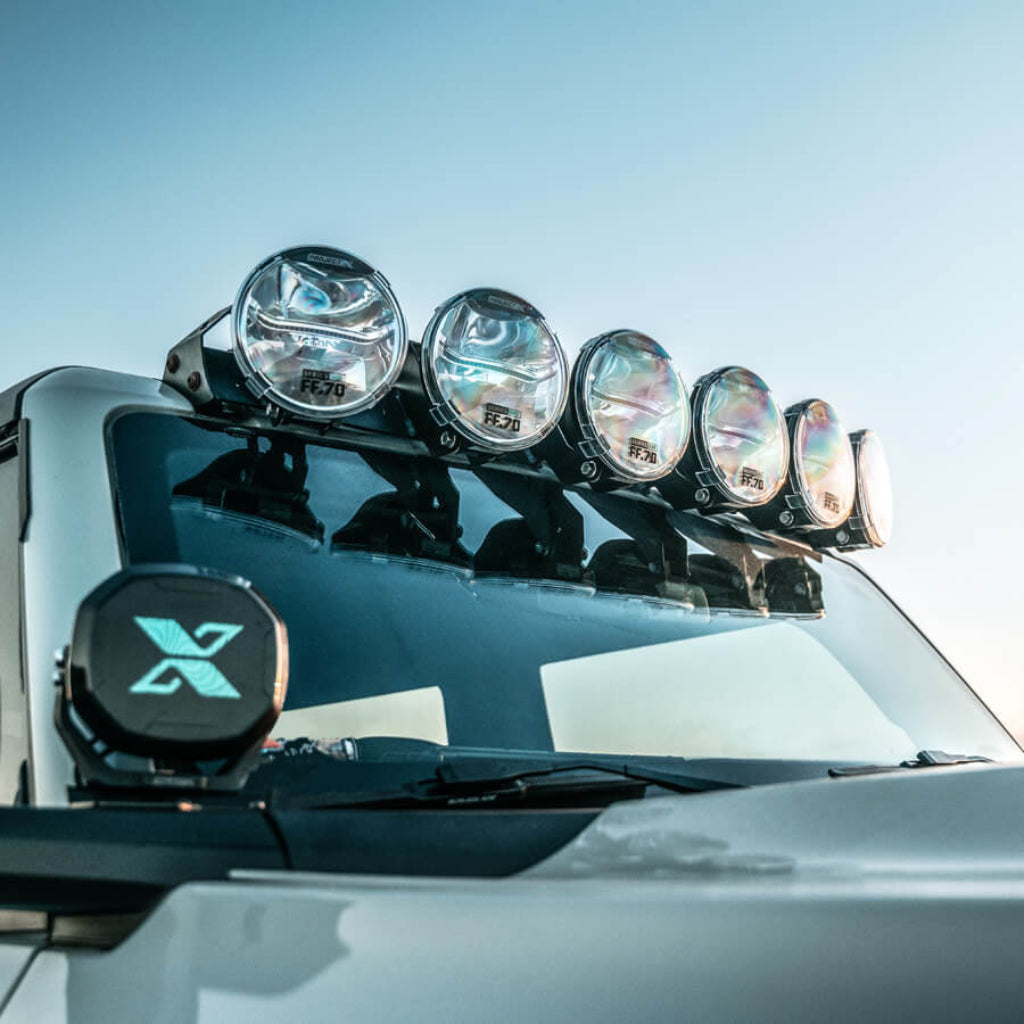
Roof mounting positions lights high and forward, giving the best beam distance on open trails and two-track roads. The PROJECT X SERIES ONE 6-Light Roof Light Bar Kit for 2021+ Bronco uses OEM Accessory Ready roof ports for bolt-on installation with no drilling. The kit includes six FF.70 lights, two floods and four spots, producing 22,800 raw lumens. The stainless steel cage bracket mounts below the windshield line to reduce wind noise and is Ghost Box compatible for wireless switching integration.
For custom builds, the Project X FF.70 Flood Beam Light and Project X FF.70 Spot Beam are available individually at 3,800 raw lumens each. The FF.90 Flood and FF.90 Spot step up to 5,700 raw lumens per light.


Bumper-Mounted Light Kits
Bumper-mounted pods sit lower and throw light closer to the ground ahead of the vehicle, useful on rocky terrain where you need to read the surface directly in front of the tires. The PROJECT X HP.70 4-Light Bumper Kit for 2021+ Ford Bronco is designed for Broncos with the OEM Modular Bumper. Four HP.70 lights deliver 15,000 raw lumens each, for a combined 60,000 raw lumens. The kit includes a bolt-on bumper bracket, Y-splitter harnesses, and all necessary hardware with no modification required.
Standalone LED Light Bars
Light bars work well for owners who want broad coverage across a single mounting point. The Vision X XPL Curved 40" LED Light Bar produces 16,585 raw lumens with an IP67/69K rating suited for water crossings and mud. For maximum output, the Vision X XPR 50" Curved Halo Light Bar runs 280W and 30,240 raw lumens. The Vision X XPR-S Halo 19" LED Light Bar is the compact option at 19 inches, suited for bumper or A-pillar mounting.
Light Option |
Output (Raw Lumens) |
Best For |
|---|---|---|
PROJECT X 6-Light Roof Kit |
22,800 |
Full roof coverage, trail riding |
PROJECT X HP.70 Bumper Kit |
60,000 |
Close-range terrain reading |
Vision X XPL 40" Bar |
16,585 |
Broad single-bar coverage |
Vision X XPR 50" Bar |
30,240 |
Maximum long-range output |
PROJECT X FF.70 (single) |
3,800 |
Individual pod, custom builds |
PROJECT X FF.90 (single) |
5,700 |
Higher-output individual pod |
Bronco Electrical Accessory Installation: Switching and Power Distribution
The biggest mistake most Bronco builders make with auxiliary lighting is the switching setup. Running multiple light pods, a light bar, a winch, and recovery gear through a single fused relay creates electrical problems and wiring that's difficult to diagnose on the trail.
The PROJECT X Ghost Box Kit, 1 Keypad + 4 Wireless Modules addresses this properly. The system uses 2.4GHz RF wireless and Bluetooth 5.0 to connect four two-circuit control modules to a control keypad, eliminating switch wiring in the cab. Each module handles two circuits, one rated at 20 amps and one at 40 amps, for eight independently controlled circuits. The system is expandable to 24 modules for heavily built rigs. The keypad mounts inside the cab with a single RJ45 connector, and modules mount near accessories outside the cab with an IP64 waterproof rating. The PROJECT X app allows circuit programming, lighting scenes, and preset configurations on iOS and Android.
Both the PROJECT X roof kit and bumper kit are Ghost Box compatible, meaning wiring connects directly to modules without additional adapters.
According to SEMA's vehicle electrical systems guide, proper circuit protection and load management are among the most common areas where DIY electrical builds fail.
Exterior Protection: Skid Plates, Rock Sliders, and Bumper Upgrades
The Bronco's body-on-frame construction provides solid attachment points for rock sliders and skid plates that protect the transfer case, oil pan, and fuel tank.

Project X FF.70 Flood Beam Light
Skid plates typically cover the front differential, transfer case, and fuel tank as separate panels, allowing incremental additions or replacement after damage. Most quality aftermarket skid plates use 3/16-inch or 1/4-inch steel with powder-coat finish for corrosion resistance. Rock sliders attach to frame rails and extend outward to protect rocker panels and door sills. On the Bronco, this is particularly relevant because factory rocker panels sit relatively low and are vulnerable on side-hill traverses. Quality rock sliders bolt to the frame, maintaining warranty compliance.
Front bumper upgrades focus on winch mounting, D-ring recovery points, and improved approach angle. The factory modular bumper is functional but limits approach angle compared to purpose-built aftermarket options. Rear bumper upgrades often include a spare tire carrier, which relocates the spare from the factory swing-out position.
Storage, Cargo Management, and Recovery Gear for Off-Road Bronco Builds
A trail-ready Bronco needs a system for carrying recovery gear, tools, and supplies with weight distributed and critical equipment accessible.
Roof rack systems mount to factory roof rails or OEM Accessory Ready ports. A quality rack adds load capacity for overlanding gear, rotopax fuel canisters, and overland boxes, but every pound added to the roof raises center of gravity. Verify the rack's load rating against the combined weight of everything being mounted before purchasing.
Recovery gear is non-negotiable for serious trail use. The practical minimum includes a kinetic recovery rope or snatch strap rated for the vehicle's gross weight, D-rings or shackles at factory recovery points, recovery boards for sand or mud, a high-lift jack or air-operated jack appropriate for tire size, and a basic tool kit and tire repair supplies.
A winch adds self-recovery capability that recovery boards and straps cannot replicate on steep inclines. Cargo management inside the Bronco benefits from modular drawer systems or cargo slides that organize gear and prevent shifting on rough terrain.
According to Overland Journal's gear organization guide, distributed weight placement, heavy items low and centered, lighter items on the roof, has a measurable effect on vehicle handling on long overlanding trips.
Weight, Fuel Economy, and Warranty: What Bronco Owners Often Overlook
Most off-road accessory guides focus on what to add. Few address what each addition costs beyond the purchase price.
Weight is the honest trade-off. A steel front bumper with a winch, skid plate package, rock sliders, roof rack, light bar, and recovery gear can add several hundred pounds to a vehicle with specific payload and towing ratings. Added weight affects fuel economy, payload capacity, suspension geometry, and braking distance.
Fuel economy impact from aerodynamic accessories, particularly roof-mounted light bars and cargo racks, varies with driving speed and accessory profile. A large light bar mounted high creates meaningful drag at highway speeds.
Warranty compatibility matters. Ford's factory warranty covers defects in materials and workmanship on factory components. Aftermarket accessories installed incorrectly or causing damage to factory systems can affect warranty coverage under the Magnuson-Moss Warranty Act. The distinction is important: the accessory itself doesn't void the warranty, but damage caused by improper installation can result in a denied claim.
As documented in FTC guidance on the Magnuson-Moss Warranty Act, a manufacturer cannot void a warranty simply because aftermarket parts were installed; they must demonstrate that the aftermarket part caused the specific failure. Accessories using factory mounting points, like the PROJECT X roof kit's OEM Accessory Ready port integration, are generally lower-risk from a warranty standpoint than modifications requiring drilling or welding.
Terrain-Specific Recommendations: Matching Accessories to Your Trail Type
The best off-road accessories for a Ford Bronco depend heavily on where that Bronco is being driven.
Rocky terrain (rock crawling, trail riding): Prioritize skid plates, rock sliders, and bumper-mounted lighting. Bumper-mounted pods illuminate the terrain directly ahead of the tires, more useful than roof-mounted distance lighting when picking a line through boulders.
Desert and high-speed off-road: Roof-mounted lighting becomes the priority. Long-distance spot beams allow higher trail speeds by extending visibility far ahead. Skid plates still matter for protecting against embedded rocks.
Mud and soft terrain: Recovery gear takes priority. Recovery boards, a kinetic strap, and ideally a winch are the most important additions.
Overlanding and multi-day trips: Cargo management and roof storage become central. A roof rack, interior cargo organization, and recovery gear for self-sufficiency matter more than maximum lighting output.
Trail Type |
Priority Accessories |
Secondary Accessories |
|---|---|---|
Rock crawling |
Skid plates, rock sliders, bumper pods |
Winch, D-rings, approach bumper |
Desert/high-speed |
Roof light kit, long-distance light bar |
Skid plates, all-terrain tires |
Mud/soft terrain |
Recovery boards, kinetic strap, winch |
Mud flaps, all-terrain tires |
Overlanding |
Roof rack, cargo management, recovery kit |
Auxiliary lighting, spare tire carrier |
The common mistake is building for the most extreme scenario a Bronco might ever see, rather than the terrain it actually runs most often.
Building a trail-ready Bronco means making deliberate choices across lighting, protection, and recovery rather than buying every available upgrade at once. DRFT Industries carries the PROJECT X and Vision X lighting lines purpose-built for the 6th Gen Bronco, including vehicle-specific roof kits, bumper pod kits, and standalone light bars. Browse the full off-road accessories catalog at DRFT Industries to find fitment-specific options for the 2021+ Bronco.
Frequently Asked Questions
What are the most essential off-road accessories for a Ford Bronco?
The highest-priority upgrades for trail use are auxiliary lighting, skid plates, rock sliders, and recovery gear. Quality LED light pods or a roof light bar dramatically improve visibility on night runs. Skid plates protect the underside on rocky terrain, while rock sliders guard the rocker panels on technical trails. A basic recovery kit — d-rings, recovery boards, and a tow strap — rounds out a trail-ready setup before you add comfort or cosmetic upgrades.
How do auxiliary lights improve off-road visibility on the Bronco?
The Bronco's factory headlights are adequate for road use but fall short on unlit trails. Aftermarket auxiliary lights — particularly roof-mounted kits or bumper pod setups — add significantly more lumens and a wider or longer beam pattern depending on whether you choose flood or spot optics. Flood beams widen your field of view close to the vehicle, while spot beams push light farther down the trail. Running both beam types together gives the most complete coverage for fast-paced or technical terrain.
Are vehicle-specific accessories better than universal parts for the Bronco?
For structural and mounting-critical parts — bumpers, rock sliders, roof racks, and lighting brackets — Bronco-specific fitment is worth it. These parts use the factory mounting points, maintain correct approach and departure angles, and generally require less modification. Universal accessories like individual LED light pods, d-rings, or recovery boards work fine as long as they're mounted to a vehicle-specific platform. Mixing both approaches is common and practical for most builds.
What electrical accessories are recommended for trail builds?
A wireless switch panel or power distribution system is one of the most practical electrical upgrades for a trail-built Bronco. It lets you control multiple accessories — lights, air compressors, fans — without running additional wiring into the cab. Systems like the PROJECT X Ghost Box use 2.4GHz RF and Bluetooth to connect modules wirelessly to a keypad or smartphone app, which simplifies installation and keeps the interior clean. Always verify your alternator and battery can handle the added load before adding multiple high-draw accessories.
Does adding off-road accessories affect the Ford Bronco's factory warranty?
Under the Magnuson-Moss Warranty Act, a manufacturer cannot void your entire warranty simply because you installed aftermarket parts. However, if an aftermarket accessory directly causes a component to fail, the dealer can deny warranty coverage for that specific failure. Bolt-on accessories that use factory mounting points carry less risk than modifications that cut, weld, or alter factory components. Check your specific warranty terms and consult your dealer if you have concerns about a particular modification before installing it.