Table of Contents
- Performance Exhaust vs Stock Exhaust: Side-by-Side Comparison
- Sound Profile, Exhaust Note, and Cabin Drone
- Exhaust System Backpressure Explained
- Material Quality, Durability, and Weight Reduction
- Emissions Compliance, Legal Standards, and Warranty Implications
- Cat-Back vs Axle-Back Exhaust: Choosing the Right System
- Cost, Fuel Efficiency, and Maintenance Requirements
- Aftermarket Exhaust Installation Tips
Last Updated: August 25, 2026
Choosing between performance exhaust vs stock exhaust comes down to more than just sound. There are real trade-offs in backpressure, material quality, emissions compliance, daily drivability, and long-term cost that most guides gloss over. This breakdown from DRFT Industries covers each factor in plain terms so you can make an informed call for your specific build.
Performance Exhaust vs Stock Exhaust: Side-by-Side Comparison
A performance exhaust system is an aftermarket replacement for the factory exhaust that uses larger-diameter tubing, less restrictive mufflers, and higher-grade materials to reduce backpressure and improve exhaust flow. A stock exhaust is engineered by the OEM to balance emissions compliance, noise regulations, cost, and broad compatibility across a range of driving conditions.
Neither is universally better. The right choice depends on how the vehicle is used.

Feature |
Stock Exhaust |
Performance Exhaust |
|---|---|---|
Tubing diameter |
Smaller, varies by OEM |
Typically 2.5"-4" mandrel bent |
Material |
Aluminized or mild steel |
T409/T304 stainless or titanium |
Sound profile |
Quiet, engineered for cabin comfort |
Varies: touring to aggressive |
Backpressure |
Higher by design |
Lower, optimized for flow |
Emissions |
Certified at factory |
Must be EPA-eligible for street use |
Weight |
Heavier (cost-driven materials) |
Often lighter, especially stainless |
Warranty |
Covered under OEM warranty |
Aftermarket warranty varies |
Cost |
Included with vehicle |
Additional investment required |
Sound Profile, Exhaust Note, and Cabin Drone
The most immediate difference between a performance exhaust and a stock unit is sound. Stock systems are specifically tuned to minimize exhaust note inside the cabin. Performance systems are not.
How Decibel Levels and Sound Frequency Differ
Sound frequency and decibel levels vary significantly across performance exhaust profiles. Manufacturers typically offer touring, street, and race profiles. A touring profile delivers moderate exhaust character without drawing attention on a commute. A race profile produces an aggressive, high-frequency note clearly audible at highway speeds.
Muffler design drives these differences. Straight-through mufflers reduce sound dampening, raising volume and frequency. Chambered mufflers, like those in the Flowmaster Super HP-2 Muffler, use laminar flow technology to produce a controlled tone without eliminating all restriction.

Cabin Drone and Interior Acoustics: What to Expect
Cabin drone occurs when exhaust sound frequency resonates with the vehicle's cabin natural frequency, typically between 1,500 and 2,500 RPM, exactly where highway cruising happens (peer-reviewed research). Trucks and SUVs with larger cab volumes are more susceptible.
Resonators in the exhaust system cancel out these frequencies. Removing a resonator or choosing a system that eliminates it entirely can introduce drone even if overall volume seems acceptable. For daily highway driving, confirm whether a system retains the resonator or replaces it with straight pipe.
Exhaust System Backpressure Explained
Exhaust backpressure is the resistance to exhaust gas flow created by the exhaust system's tubing diameter, bends, muffler design, and catalytic converter (sae.org). Stock systems are engineered with specific backpressure targets that balance low-end torque, emissions performance, and fuel efficiency.
The relationship between backpressure and performance is nuanced. Some backpressure at low RPM supports exhaust scavenging, the process by which outgoing exhaust gases help pull fresh intake charge into the cylinder. Eliminating too much backpressure can reduce low-RPM torque even while freeing up top-end power.
Mandrel-bent tubing maintains consistent tailpipe diameter through every curve, preserving exhaust gas velocity and improving overall flow without necessarily eliminating all backpressure.
Horsepower Gains, Torque Curve, and Throttle Response
Results from a cat-back exhaust vary by engine, vehicle, and system design. A cat-back replaces everything from the catalytic converter back, so the catalytic converter restriction remains. Gains are typically modest on naturally aspirated engines but more pronounced on turbocharged applications where exhaust flow directly affects turbo spool.
Throttle response improvement is often more noticeable than peak power gains. Reducing exhaust restriction allows gases to exit faster, improving engine responsiveness in the mid-RPM range.
Material Quality, Durability, and Weight Reduction
Stock exhaust systems use aluminized steel, cost-effective and adequate for most climates. The trade-off is corrosion resistance. In northern states where road salt is used, aluminized steel systems often rust through before the vehicle wears out.
Stainless Steel vs Aluminized Steel vs Titanium
T409 stainless steel is entry-level stainless, offering meaningfully better corrosion resistance than aluminized steel. It's appropriate for most climates and daily driving.
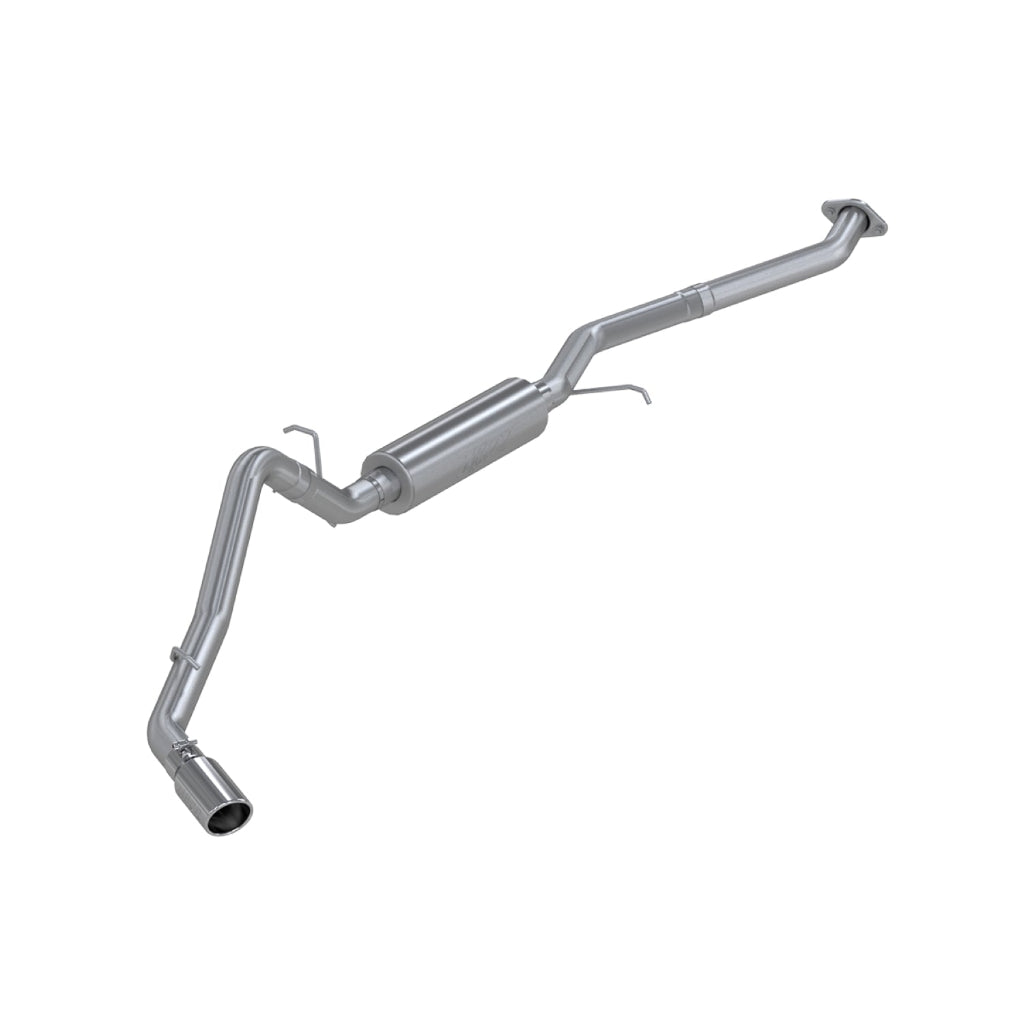
T304 stainless steel is the premium grade, withstanding extreme environments including snow, salt exposure, and off-road use without surface corrosion. MBRP's Armor Pro series uses T304 throughout, including the MBRP Armor Pro Cat-Back Exhaust for 2009-2018 Silverado/Sierra 1500 and the MBRP Armor Pro Ram 4" Cat-Back Single Side Exhaust for 2014-2026 Ram 2500/3500.

Aluminized steel remains legitimate for dry climates or budget-conscious builds. The MBRP Armor Lite Cat-Back Exhaust for 2009-2023 Dodge/Ram 1500 uses heavy-gauge aluminized steel with zinc-plated finish.
Titanium sits above T304 in weight reduction and heat discoloration resistance. It's primarily found in high-end performance applications where weight savings matter more than cost.
Weight reduction from stainless or titanium versus stock aluminized steel can be meaningful on trucks. Less undercarriage weight improves handling marginally and reduces overall vehicle weight.
Emissions Compliance, Legal Standards, and Warranty Implications
The EPA regulations on mobile source emissions prohibit removal or defeat of any emissions control device on vehicles operated on public roads, including the catalytic converter. A cat-back exhaust retaining the OEM catalytic converter is generally EPA-eligible for street use, provided it doesn't defeat other emissions controls. Systems replacing or removing the catalytic converter are legal only for closed-course competition.
Many states enforce additional emissions testing. California follows CARB standards stricter than federal EPA rules. A system that is EPA-eligible may fail California emissions inspection without a CARB Executive Order number. Check specific emissions certification before purchasing for street-registered vehicles.
Under the Magnuson-Moss Warranty Act, a dealer cannot void the entire vehicle warranty simply because an aftermarket exhaust was installed. However, if the exhaust modification causes a specific failure, the OEM is not obligated to cover that failure. The burden of proof falls on the manufacturer to demonstrate the aftermarket part caused damage.
Cat-Back vs Axle-Back Exhaust: Choosing the Right System
A cat-back exhaust replaces everything from the catalytic converter outlet to the exhaust tips, including the mid-pipe, resonator, muffler, and tailpipe. An axle-back exhaust replaces only the section from the rear axle to the tips, typically just the muffler and tailpipe.
A cat-back system has more tubing to optimize, meaning more potential for improved exhaust flow, better sound tuning, and weight reduction. An axle-back is simpler and less expensive, primarily affecting sound with minimal performance impact.
For trucks and SUVs seeking noticeable improvement in both sound and performance, a cat-back is more effective. Axle-back systems make sense for limited budgets or purely cosmetic goals.
Cold Start Characteristics and Daily Drivability
Cold start behavior changes with a performance exhaust. Stock systems manage cold-start emissions and noise, sounding different for the first minute. A performance system, particularly with a less-restrictive muffler, will be noticeably louder during cold start.
On vehicles with active exhaust systems using electronically controlled valves, an aftermarket cat-back may or may not retain full valve functionality. Compatibility varies by system and vehicle.
For daily drivers, touring-profile systems deliver improved exhaust note and performance benefit without the fatigue of a race-profile system on extended commutes.
Cost, Fuel Efficiency, and Maintenance Requirements
A cat-back exhaust alone is unlikely to produce meaningful fuel economy change for most naturally aspirated street vehicles. Reduced backpressure can improve combustion efficiency slightly, but real-world fuel consumption effects are generally small. Turbocharged engines may see more noticeable improvement if exhaust restriction was limiting boost efficiency.
Maintenance requirements for stainless steel performance exhaust are minimal compared to stock aluminized systems. Stainless resists corrosion and doesn't require the same rust attention. Clamps and hangers should be inspected periodically, particularly after off-road use.
The MBRP Armor Pro series carries a lifetime warranty. The Armor Lite carries a 3-year warranty. Stock systems are covered under OEM bumper-to-bumper warranty for the warranty period, then replaced at owner expense when they fail.
Aftermarket Exhaust Installation Tips
Most cat-back and axle-back systems from reputable manufacturers are designed for bolt-on installation without welding. Installation complexity varies by vehicle, system design, and existing exhaust hardware condition.

Before starting:
- Penetrating oil matters. Factory exhaust hardware on trucks with mileage is often seized. Soak all bolts, clamps, and hangers with penetrating oil at least 24 hours before removal. Rushing this step causes broken studs and stripped hardware.
- Confirm fitment before ordering. Cab configuration, bed length, engine displacement, and drivetrain type all affect which system fits. Requirements vary by vehicle and application.
- Cutting may be required. Some systems note that cutting may be required for proper fit on certain cab/bed combinations. This is normal and doesn't indicate a fitment problem.
- Allow the exhaust to cool before final tightening. Stainless steel expands with heat. Tightening clamps after one heat cycle ensures a more secure, leak-free connection.
- Check for heat shield clearance. Confirm clearance after installation before driving.
DRFT Industries carries the full MBRP Armor lineup and Flowmaster mufflers, all qualifying for free shipping on most orders.
Deciding between a performance exhaust and the stock system is a practical question about how the vehicle is used, where it's driven, and what the build needs. For trucks and SUVs used in demanding conditions, the material and durability advantages of a T304 stainless cat-back system make a strong case independent of sound and performance benefits. DRFT Industries carries EPA-eligible MBRP and Flowmaster exhaust systems across a range of sound profiles and price points, with free shipping on most orders. Browse the exhaust catalog at DRFT Industries to find the right fit for your vehicle.
Frequently Asked Questions
Does a performance exhaust actually increase horsepower?
A performance exhaust can increase horsepower by reducing backpressure and improving exhaust flow and exhaust scavenging. The gains depend on your engine, the specific system, and whether other modifications are present. A cat-back system on a stock engine typically produces modest gains. Pairing it with intake or tune upgrades generally produces more noticeable results. Manufacturer-listed horsepower and torque figures for specific systems vary, so check the product specs for your application.
Will an aftermarket exhaust system void my vehicle warranty?
Under the Magnuson-Moss Warranty Act, a dealer cannot void your entire factory warranty simply because you installed an aftermarket part. However, if a dealership can demonstrate that your aftermarket exhaust directly caused a specific failure, that component's warranty coverage may be denied. EPA-eligible systems that retain the catalytic converter carry less risk than muffler-delete or resonator-delete setups. Always verify emissions compliance for your state before purchasing.
What is the difference between a cat-back and axle-back exhaust?
A cat-back exhaust replaces everything from the catalytic converter back, including the mid-pipe, resonator, muffler, and tailpipe. An axle-back system only replaces the muffler and tips behind the rear axle. Cat-back systems offer more significant exhaust flow improvement and sound change because they replace more of the system. Axle-back systems are less expensive and easier to install, but the performance and sound impact is generally smaller.
Are performance exhausts legal for street use?
Most bolt-on cat-back exhaust systems that retain the catalytic converter are street legal at the federal level and carry EPA-eligible status. State regulations vary significantly, particularly in California, which enforces CARB standards. Some states also have noise ordinances that set decibel limits. Muffler deletes and straight-pipe setups are frequently illegal for street use. Always confirm your system's compliance with your state's emissions and noise regulations before installing.
How does exhaust pipe diameter affect engine performance?
Tailpipe diameter affects exhaust gas velocity and flow. Too small a diameter creates excessive backpressure, restricting performance. Too large a diameter can reduce exhaust gas velocity, which hurts exhaust scavenging at lower RPMs and can soften low-end torque. Most aftermarket cat-back systems for half-ton trucks use 3-inch tubing, while heavier-duty applications often step up to 4-inch. The right diameter depends on your engine displacement, intended use, and whether the vehicle is tuned.